Tuesday, April 3, 2012

What is Osteopathic Body-Coaching?


Before I explain what Osteopathic Body-Coaching is let me go back to the essence of osteopathy and the different approaches within osteopathy. 

(see previous blogs for more information)
Osteopathy
Osteopathy is a manual facilitated health care approach based on the principles that: 
  • The body a is a dynamic unit
  • In the body all parts are interrelated and interdependent
  • The body possesses a self regulatory and self healing mechanism.
Osteopathic Manipulative Treatment (A.T. Still)
The osteopath is there to aid the perturbed self regulatory and self healing mechanism and relieves through the use of different techniques the disturbances of motion.
Cranial Osteopathy (W.G. Sutherland)
Cranial Osteopathy is a more refined form of osteopathy that uses the stimulation of the Primary Respiratory Mechanism (PRM) to encourages the release of stresses and tensions throughout the body and head.
Biodynamic Osteopathy (J. Jealous)
In Biodynamic Osteopathy no force or manipulation is applied. The osteopath is a catalyst for the self healing and self regulatory system to go through 'the Neutral' from where healing can start. 
Osteopathic Body-Coaching 
Developed by Tom Meyers Osteopathic Body-Coaching brings together the three osteopathic trends: structural, cranio-sacral and biodynamic. It is especially suited for conditions triggered by the effects of stress: neck and back pain, digestive problems, headaches, slow healing of injuries, insomnia, cognitive impairment,...

Osteopathic Body-Coaching is a Body-Mind approach. Mind-Body approaches like positive affirmations and Mindfullness are very popular and well researched. A body-Mind approach - although as old as life itself - is a lesser known. Current therapies are based on the dualistic view that body and mind are separate and it is only know that through neurosciences that scientists come to understand that body and mind are a unit.

Osteopathic Body-Coaching as previously mentioned is recommended for people suffering from stress. Chronic stress creates physical tension (neck, shoulder, back,...) but also has a negative influence on the immune system, digestion (stomach ulcers) and the way we think (concentration problems, difficulty making decisions,...)  and feel (moody, no energy, it's all too much, procrastination,...). Osteopathic Body-Coaching facilitates the innate healing mechanism to Reaset (Return to Ease) the stress response and thus has a positive influence on all the above.

Osteopathic body-coaching has also an energetic component through biofield facilitation (some known it by the name of aura). We are not only body and mind... we after all energy.

AND IF THAT WASN'T ENOUGH

An osteopathic body-coach is also an elementary health care coach. We must unlearn that we can't help ourselves and learn that we can and more that we can help others too. This sharing of health information is done during the consultations but also in trainings where everyone is welcome. For more information visit www.biomotions.com


Biofield: "It's a complex energy structure of different fields, different natures, and different origins. There are electromagnetic and gravitational fields, as well as fields of molecules and, to some extent, fields of unknown parameters. So the biological field of a living thing, also known as its "aura," is an invisible structure that correlates its activity to create a unique and united system." - Dr. K. Korotkoc 

http://www.spiritofmaat.com/archive/aug3/korotkov.htm

What is Biodynamic Osteopathy?

Continuation from the previous blog: http://osteopati-jonkoping.blogspot.se/2012/04/what-is-cranial-osteopathy.html


Biodynamic Osteopathy was developed by James Jealous and is based on W.G. Sutherlands' Cranial Osteopathy
J. Jealous added another element termed 'the Neutral'. This neutral is achieved without any force or interference applied by the osteopath. The osteopath is there to facilitate the inherent Breath of Life, the life force within the Primary Respiratory Mechanism (PRM). 
The neutral can be seen as the midpoint between (thoracic) breathing in and breathing out cycle but then within the PRM. In disease, with injuries,... this PRM cycle is disregulated and causes interference in the healing process.


More information: http://www.biodo.com/

What is Cranial Osteopathy?


(sometimes also refered to as cranio sacral therapy)
Osteopathic Manual Treatment (OMT) was developed by Dr. A.T. Still (1828 - 1919). Cranial Osteopathy or Osteopathy in the Cranial Field (OCF) on the other hand was developed by W.G. Sutherland (1873 - 1954) a student of Dr. Still. 
Cranial osteopathy is a more refined form of osteopathic treatment (no manipulations of the spine) that encourages the release of stresses and tensions throughout the body and head using the Primary Respiratory Mechanism (PRM).
Primary Respiratory Mechanism
According to Sutherland there is a dynamic interrelation between the cerebrospinal fluid (CSF) and the physiological function of all cells in the human body and in particular those of the nervous system.
Primary - It is a system that comes “first.” It underlies all of life's processes and gives dynamism, form and substance to all of anatomy and physiology, driving all functions of the body.
Respiratory - It is the spark that gives rise to the breath as it moves through the tissues. It is the foundation of metabolism. It enables the exchange of gases and other substances between compartments of the body.
Mechanism - It manifests as a specific motion of the body, a system composed of many parts that work together to create a whole, greater than the sum of the parts.
The 5 components of the PRM
  • The fluctuation of the cerebrospinal fluid (Breath of Life).
  • The function of the reciprocal tension membrane.
  • The mobility of the neural tube.
  • The articular mobility of the cranial bones and the involuntary mobility of the sacrum between the ilia.
According to Sutherland the main function of this mechanism is to unimpeded metabolic processes in the body.


More information: http://www.cranialacademy.org/cranial.html

What is osteopathy?


Osteopathy is a manual facilitated health care approach based on the principle(s) that the body is a dynamic unit in which all parts are interrelated and interdependent and which possesses a self regulatory and self healing mechanism. 
Manual
An osteopath uses his fine-tuned sense of touch to feel disturbances in motion within the body-matrix. Health is when the body's motions (skeletal, muscular, facial, organic,...) are in balance. 
Hence the word 'BioMotions' (name of my website) or life in motion.
Facilitated
The osteopath is there to aid the perturbed self regulatory and self healing mechanism and relieves through the application of different manual techniques the disturbances of motion. The aim is to enhances vitality and overall functioning of the patient. 
Osteopathic Manual Technique (OMT) includes amongst others:
  • Soft-Tissue Techniques
  • Spinal corrections
  • Fascia Therapy
  • Muscle Energy Technique
  • Lymphatic Technique
  • Abdominal Technique
Dynamic unit
The current conventional medicine model is based on the basis that body and mind are split (dualism). In osteopathy body and mind are part of an interrelated and interdependent whole.
Self regulatory and self healing mechanism
The human body is always working to maintain a state of balanced function. For example, blood pressure, blood sugar and the heart rate are actively kept within a normal range. When there is a laceration or tear in the tissues, a physician can assist by cleaning the wound and bringing the edges together, but healing occurs by the action of inherent forces and processes within the body. 1
Dr. A.T. Still (The father of osteopathy) stated, “All the remedies necessary to health exist in the human body.” He understood that within the tissues, there is an inherent wisdom, a wise all-knowing restorative force, an intelligence within every cell that keeps the body well. When a state of discord arises, this healing force acts to restore functional balance and harmony. Sometimes the body’s self-healing forces can be impaired or impeded by disease or structural imbalance. The osteopathic physician is trained to augment these intrinsic mechanisms to help the body to better and more quickly heal itself. 1

Sunday, January 29, 2012

Osteopathic Body-Coaching as a therapy for depression


Following is an email I wrote in response to a query about what Osteopathic Body-Coaching can offer from a person that suffers from severe depression.

Dear Sir / Madame,

You've asked recently for some more information about my work in relation to stress and depression and thus how body-coaching can help with matters of the mind. Before I try to describe to you my understanding of how the body can displace the mind, I would like to say that as far as I know there is still no consensus of what depression really is or what the physical or psychological cause is. There are good leads such as people with depression have shown abnormal levels of the neurotransmitters norepinephrine, serotonin and dopamine but there other explanations too, including genetic. I think depression can’t be narrowed down to a singular cause but is the result of many factors.
That being said I like to start with how I got interested into the body-mind link.
From the first days as an osteopath my patients, reported after their first visit improvement or complete disappearance of their physical ailments which were mainly neck, shoulder or lower back pains for which they had come to visit me. However many patients also reported improvement of cognitive functions and kept on saying things like, since your treatment: I can focus better, make better decisions and faster, I can concentrate more and feel less anxious when something goes wrong, I have the same amount of stress but I don't care as much, I have more time. 
My response was great but at the same time started to question this positive side effect. What also was given as feedback was that with people who had visited other osteopaths before coming to my practice, that they hadn't experienced that kind of a cognitive improvement. However, that can mean several things like maybe they weren't stressed then.
Still it seemed I was offering something different and I wanted to know why.
The first question I asked myself was what lesions do these patients have in common? Lesions are disorders of function and movement of the body, detected and assessed by careful palpation of the bone structures, joints and soft tissues. I was especially interested in cranial lesion patterns (The cranium is made of different bone structures: occiput, temporal bone, frontal bone, sphenoid etc). 
I reasoned that it was rather the interaction with cranial structures (cognition taking after all place in the head) what was making the main difference rather then the work for example on the knee or foot (osteopathy is a holistic approach). 
I went looking into patient records and did find that certain lesions were indeed nearly always present in various cases. 
The next step was that I explained to new patients - who hadn't mentioned their state of mind and by whom I found the lesion patterns - that people with a pattern like theirs often felt that they had difficulty concentrating, felt a bit lost, had difficulties focusing etc. Most did respond that they also felt like this. After the treatment they also reported improvement in their behavior, state of being. 
The treatment itself is performed with the person fully clothed lying on a massage table. I palpate the different parts of the cranium and the rest of the body in a specific manner, to feel if movement is normal or if there are lesions. Normal movement feels like a wave that goes rhythmically to and fro. This wave is felt but not visible by the eyes. Lesions on the other hand feel more like a palpable pulling into one direction more then another or no movement at all. 
When a lesion is found the hands are kept there and initiate the unwinding process, to reinstall rhythmic movement, ease and relaxation. The process - characterized by three phases: Engagement phase, Fulcrum (dynamic still point), disengagement phase - is carried out by the body itself the role of the osteopathic body-coach is to be there and to let the process unfold. 
These three phases is very similar to what one can find back in the breathing cycle: inspiration (tension of muscles), still point between inspiration and expiration, followed by expiration (relaxation). 
This unwinding process improves among other things the circulation of blood, lymph through the release of tensions. I do like to mention here that I do not exclude that this way of working probably also has an impact on the flow of energy in the Chinese meridian system and other energy centers. (I just don't know and thus do not want to exclude that there is far more going on then that I know or that science can prove.)
The question "Why does Osteopathic Body-Coaching have an impact on the mind?" is still to be answered. I don't have a conclusive answer but found some interesting leads in the book "Why zebras don't get ulcers" from Stanford University professor Robert. Sapolsky. 
In brief:
The stress (fight & Flight) response, build for acute alarm situations, triggers the release of many hormones including adrenaline and glucocorticoids. Glucocorticoids i.e. mobilizes energy, inhibits storage of energy and suppresses immune function.  Adrenaline, has an influence on i.e. blood pressure, heart rate, breath rate which are increased.  Adrenaline is also a vasoconstrictor in certain parts of the body (ex. digestive system) to have more blood supply to the area's of the body that are needed to act in the fight and flight response.
The stress response however, when chronically stimulated, can become more damaging then the stressor itself: heart disease, diabetes, ulcers, growth problems,...
In the brain chronic stress or the release of glucocorticoids will decrease glucose delivery to the hippocampus (Limbic system: emotion, memory,...) and cortex (neocortex and prefrontal cortex: cognitive region,...) to probably divert it to the more reflexive brain regions (reptilian brain: survival)
I've written to Dr Sapolsky asking if this decrease of glucose delivery was due to a vasoconstriction in parts of the brain. He responded that it was more likely to be a tightening of the blood brain barrier which results in less nutrients entering the extracellular space. Less nutrients in this space means less for the neurons to take up. Neurons are known for their high energy use so if there is lower supply there is also lower functioning and even atrophy can set in.
There is also evidence that prolonged exposure to stress or glucocorticoids can actually kill hippocampal neurons. This is seen in people with major depression where they have noted volume loss of the size of the hippocampus.
The next interesting bit of information is that the hippocampus is also one of the important negative feedback sites in the brain controlling glucocorticoid secretion. Damaged or dysfunctional hippocampal neurons dysregulates the negative feedback system for glucocorticoid secretion and thus there is no 'stop' in the production of it. So when the hippocampus is damaged more glucocorticoids are released which damages the hippocampus further and then even more glucocorticoids are being released, causing a degenerative cascade.
I have no prove of it yet but I believe that the osteopathic body-coaching approach has positive influence on stimulating the parasympathetic nervous system: promoting i.e. relaxation, vasodilation (in those parts of the body that had gone into vasoconstriction due to sympathetic stimulation) and the regulation of the blood brain barrier so that nutrients including glucose is again available in the limbic system and cortical regions of the brain (improves cognitive function). In other words it lowers / regulates the stress response or as I call it 'reasets' (yes with an a) meaning returning to the state of ease.
The feedback I have from my patients seem to point towards this effect although other reasons can not be excluded for why they felt less stressed or depressed and why their cognitive abilities improved.
How many osteopathic body-coaching sessions does one need? I don't know there are so many factors that play a role here. Most people that came to my practice actually came for physical problems so I guess their level of depression wasn't that high. However, left unattended this could have resulted in a more serious problem.
Is osteopathic body-coaching the miracle cure? No, I'm convinced that body-coaching has a place in health and wellbeing. However, if we keep being overstimulated physically, psychologically or create stress through anticipation (to worry ourselves sick) it will only offer short term relieve. This short term relieve however in the long term is not to be underestimated as it opens the gateways for new insights.
For people with PTSD or who are suffering from major depression osteopathic body-coaching should be offered along with psychotherapy or coaching but also with learning specific breathing exercises (from Mindfulness or the Heartmath institute) that are practiced several times a day.

I hope this answers your question but please do not hesitate to contact me if you have any other questions you like to ask.

Tom

Sunday, September 4, 2011

The engaging touch: A self-help tool that leads to a state of ease.


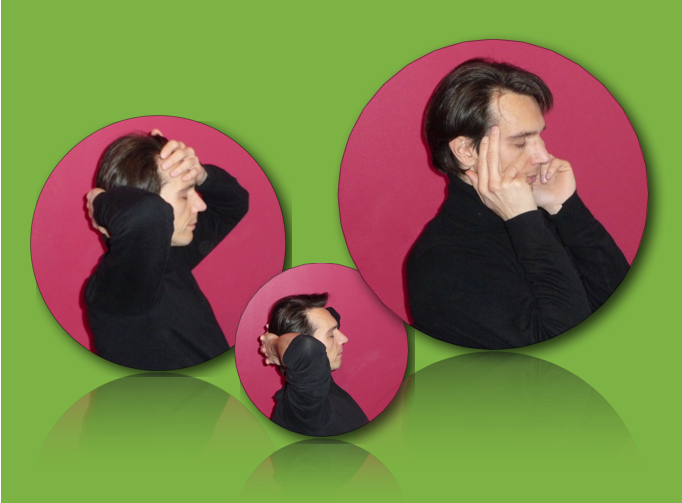
Touch is the most important underestimated health promoting self-help tool that I know. It’s a tool that we always have with us wherever we go and in whatever situation we find ourselves. Touch is also an innate reflex activated when we experience physical pain. However not only with physical pain, we also have a reflex touch when we have to deal with emotions - we touch our heart, stomach, abdomen or even touch one another through an embrace - or in times of stress we reach for our forehead, temples or neck.  
An example when we instinctively touch our forehead is when we’re trying to remember a name. “That business parnter I spoke to earlier, what was his name again?” and automatically the hand goes up in the direction of the forehead. Sometimes we barely touch it and sometimes we hold or rub it for a few seconds.
Have you ever wondered why we do this, or why you rub your temples when you are stressed, touch the back of your head when you know you’ve done something you realize you shouldn’t have? 
Some of these innate reflexes are unfortunately slowly disappearing through negative conditioning. We don’t have time anymore to rub our temples or hold our forehead, or so we think. We’ve got better things to do! But do we? 
What if in that touch lies the solution, or at least the solution to think clearly again, to overcome the inhibiting emotion or physiological stress response. Touch, thus creating a state of mind that is calm again and can reflect about a certain situation instead of being overwhelmed.
I see how this reversal from a state of stress to one of ease is happening every day in my osteopathic body-coaching practice. I can see how people walk in overwhelmed or in freeze mode which translates itself often in muscular tension in back and neck and when they leave the muscle tensions are gone but also with it the stress and the primitive mind state. People leave with the words, ‘I feel lighter, like a veil that has lifted from me’ and ‘I can see the forest through the trees again’. Physical and psychological tension relief all facilitated through a therapeutically applied touch. 
But you can achieve this too! You have all the potential to help yourself far more then you might think.
To help understand how you can help yourself is to understand the natural principle of engagement and disengagement. This dynamic lies at the basis of creating a state of ease. Observe your breath, you have an active inspiration phase where muscles are tensed to fill the lungs: Engagement. What follows is the automatic and completely effortless expiration phase: disengagement.
Touch as an interaction with the self healing mechanism of yourself or another - even if it is through a reflex - is the engagement phase.  In others, the engagement could be portrayed in embracing a child or adult in distress. On yourself (or others) it could be by putting your hand on your forehead, temples or on the back of your head or shoulders. The disengagement and automatic release phase is when you let go of the child or adult when he or she stops crying, the breath is regular again, when they are out of the survival mode. By ourselves (or others) it is when we feel a calm again and also that the breath is more regular. 
There are many points and areas through which the state of ease can be facilitated. The three most effective however are the temples, the forehead and the back of the head called occiput. The temples because it is closely linked with the pituitary gland and amygdala structures in the brain that are activated during the stress response. The forehead seeing that behind it lies the prefrontal cortex which is the area of the brain associated with thinking, adaptation, creativity, feelings and control our emotions. The back of the head (occiput) as it is part of the neocortex which gives insight, vision. 
Practically: “The engaging touch”
The touch should be light, barely touching the skin. You don’t massage or rub, you engage with feeling and sensing.. Ask yourself, how does this area feel? Is it frozen, still or can I feel movement? Whatever you feel just engage with it, let whatever process that emerges happen. Just like you would unwind two spirals that are intertwined with each other follow the tensions that are present without strength nor strain until you feel a process of release. This is the disengagement that emerges automatically and can sometimes feel like a huge inflation of a balloon.  
To optimize the engagement process you can add a rhythmic breathing exercise with a sequence of 5 seconds inspiration following a 5 seconds expiration. Or while you are in the engagement phase you can add a positive feeling. I mostly think of the sun that shines on me and warms me deep within.
But in the engagement phase you can add all the tools that you have learned from Reiki to NLP or others as long as it feels right to you in that moment. 
The return to a state of easy lies in your hands. Start today with applying the above consciously and see for yourself. 


For more information go to www.biomotions.com

BioMotions® body-coaching is a new complimentary ‘body-mind’ health approach that goes beyond classical osteopathy. It is developed by Tom Meyers and facilitates, by means of micro-movements, the self healing processes that have been perturbed by the effects of stress or trauma. Thus promoting physical, physiological and psychological wellbeing. 
BioMotions Body-Coaching as a Self-Help Tool by Tom Meyers is licensed under a Creative Commons Attribution-NonCommercial-ShareAlike 3.0 Unported License.
This work is licensed under the Creative Commons Attribution-NonCommercial-ShareAlike 3.0 Unported License. To view a copy of this license, visit http://creativecommons.org/licenses/by-nc-sa/3.0/ or send a letter to Creative Commons, 444 Castro Street, Suite 900, Mountain View, California, 94041, USA.

Monday, May 2, 2011

Body or Mind approach when dealing with depression?

Nowhere is the body - mind connection and it’s impact on wellness and illness more obvious then in depression. Depression affects the mind, which involves feelings of sadness and decreased energy having an impact on ones’s ability to perform everyday tasks. However, the major underlying cause to these matters of the mind is a biochemical imbalance due to a malfunctioning of the physiological stress response, thus making it a physical problem! 
So if it is a physical problem, would you then still think it logical that a talk therapy is the place to start your healing?
I’m not saying that talk therapy doesn’t help, it does and it has it rightful place in a treatment package that is suited to the individuals demands and path to recovery. But to start talk therapy when the underlying cause is on a physical level seems a bit odd. 
A brief description of the stress response might give us an ‘aha but of-course’ moment backing up the idea that a mind approach is maybe not the most efficient treatment to consider when suffering from depression and burnout.
A good functioning stress response will activate the fight and flight mechanism after a threat or challenge has been perceived and returns to normal when the threat or challenge is over. 
An activated fight and flight mechanism is associated with among other things the release of the stress hormones adrenalin and cortisol and the physiological changes of heart rate, blood pressure, breath rate which increase and incoherence of the heart rate variability*. This in turn will have an effect on thoughts, actions, feelings and more: Heightens our alertness, gives focal vision, tenses certain muscles, digestion is halted,...  
Problems start when the stress response doesn’t return to a state of ease and thus continues pumping stress hormones into the bloodstream and therefore heart rate, blood pressure, breath rate stay elevated and heart rate variability remains incoherent. Short-term, this will have an impact on (job) performance, loss of general overview, misreading situations, short-temperedness, agitation,... Longterm, it effects - on top of all the previous - our immune system resulting in becoming more prone to bacterial and viral infections,  heart disease, mood and character changes,... 
In an early stage, a malfunctioning stress response can be facilitated back into balance by for example the Heartmath’s Quick Coherence® Technique: using heart focus, heart breathing and heart feeling. This exercise can also be applied in a daily practice as a preventive tool. 
However, when the stress response is out of balance for a longer time and physical side-effects are starting to show and have a negative impact on our general wellbeing - aches and pains, mood swings, insomnia,... - then a more comprehensive treatment that includes a physical and energetic approach is necessary.
BioMotions® Body-Coaching is such a health approach. It facilitates, by means of involuntary micro-movements, the self healing processes that have been perturbed by the effects of stress or trauma. Thus promoting physical, physiological and psychological wellbeing.

BioMotions® Body-Coaching is based on the single universal ‘tidal’ principle and can be applied as a stand-alone holistic approach or it can be integrated in an existing practice: Psychotherapy, coaching, massage, reiki,...
The benefits of BioMotions® Body-Coaching is - among other things - that:
  • It is based on a principle and not a technique and therefore very versatile to any given situation.
  • It can be applied any place and any time
  • It has no negative side-effects
  • It has an immediate positive effect on the physiology of stress
  • It is simple and straightforward
  • Anyone can learn it
BioMotions® Body-Coaching does not cure but it brings back the potential of healing through the regulation of the malfunctioning physiological stress response. 
When the biochemistry balance is restored and the individual needs extra support to steer his or her life into a new direction or needs help with putting a new perspective on a situation, psychotherapy or coaching for that matter can provide a great contribution. 
Love and Light


Tom

*HRV = a physiological phenomenon where the time interval between heart beats varies. It is measured by the variation in the beat-to-beat interval
Creative Commons License